


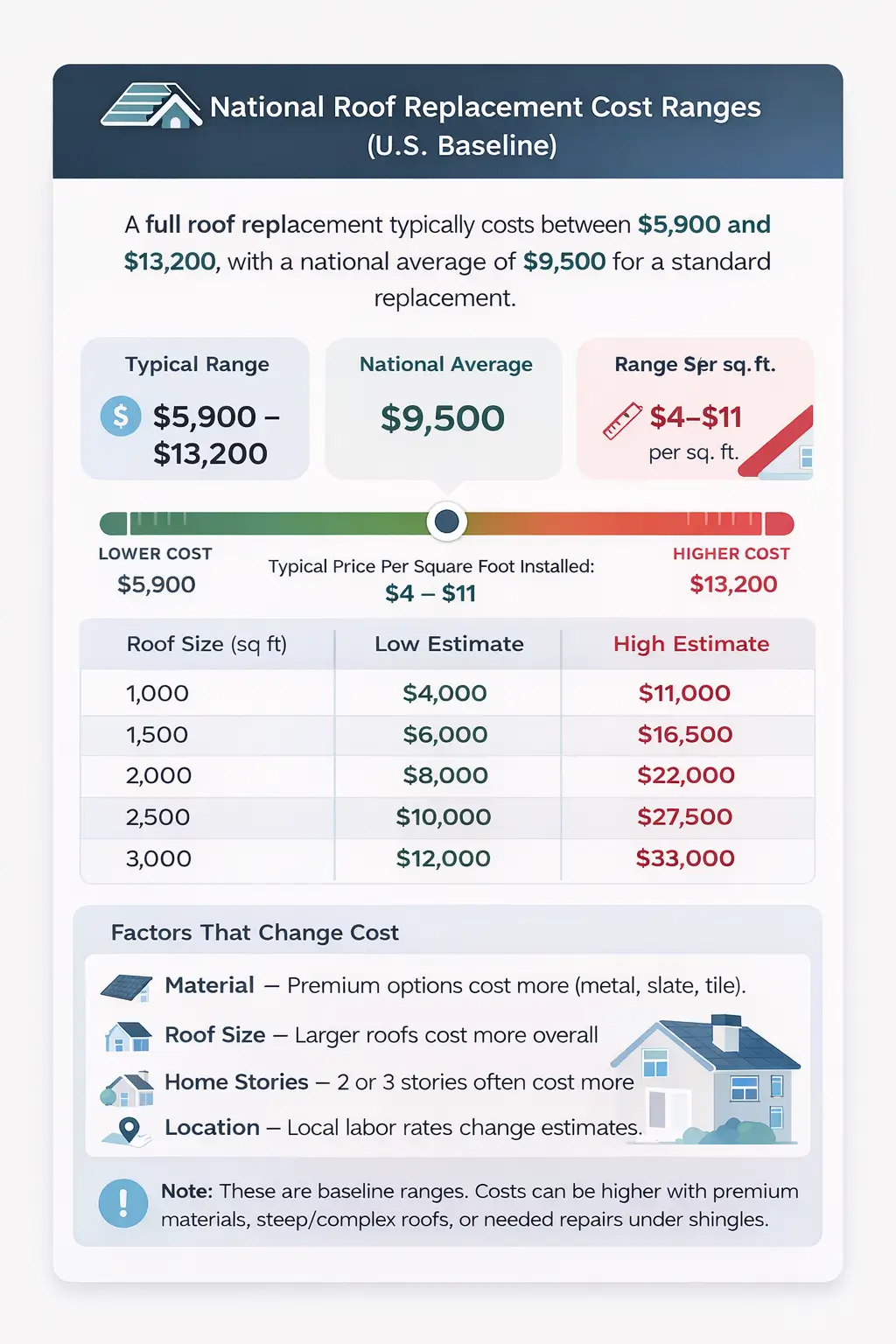
If you want a fast budget answer to how much a new roof costs, home size helps—but roof size matters more. Still, many homeowners use roof square footage as the best planning number.
A common U.S. planning range for a full replacement is about $4 to $11 per square foot installed for typical materials and standard complexity. That range covers many normal asphalt-shingle roof projects, but your final cost can increase if your roof is steep, complex, or needs wood repair under the shingles.
| Roof Size (sq ft) | Low Estimate | High Estimate |
|---|---|---|
| 1,000 | $4,000 | $11,000 |
| 1,500 | $6,000 | $16,500 |
| 2,000 | $8,000 | $22,000 |
| 2,500 | $10,000 | $27,500 |
| 3,000 | $12,000 | $33,000 |
If you're trying to understand how much a roof costs for your home, find your roof size (a roofer can measure it quickly). Then use the range above as a starting point. After that, adjust for material and any repairs.
When people ask how much it costs to replace a roof, they often forget that home height affects labor time and safety requirements. Taller homes require more setup, additional safety equipment, slower material handling, and extended cleanup time.
Contractors typically calculate this by starting with a base price for the roof size and material, then adding a height factor.
| Home Stories | What Changes | Cost Impact |
|---|---|---|
| 1 Story | Easiest access, fastest work | Baseline (no extra) |
| 2 Story | More safety setup, slower loading | 5%–15% higher |
| 3 Story | Highest risk, more staging | 10%–25% higher |
If a one-story home costs $10,000 for a roof replacement, a similar two-story home might be closer to $10,500–$11,500, and a three-story home might be closer to $11,000–$12,500 (if everything else is the same).
A common U.S. planning range for a full replacement is about $4 to $11 per square foot installed for typical materials and standard complexity. That range covers many normal asphalt-shingle roof projects, but your final cost can increase if your roof is steep, complex, or needs wood repair under the shingles.
Material choice is one of the biggest reasons two quotes can be very different. If you are comparing roof replacement cost options, think in two parts:
| Roofing Material | Typical Installed Cost (per sq ft) | What to Know |
|---|---|---|
| Asphalt Shingles | $4 – $11 | Most common choice; good balance of cost and performance |
| Metal Roofing | $4 – $30 | Wide range: basic metal costs less; premium metal costs more |
| Slate | $10 – $30+ | Heavy and premium; may need stronger structure |
| Tile (Clay/Concrete) | Often higher than asphalt | Durable but heavy; labor and underlayment can increase total |
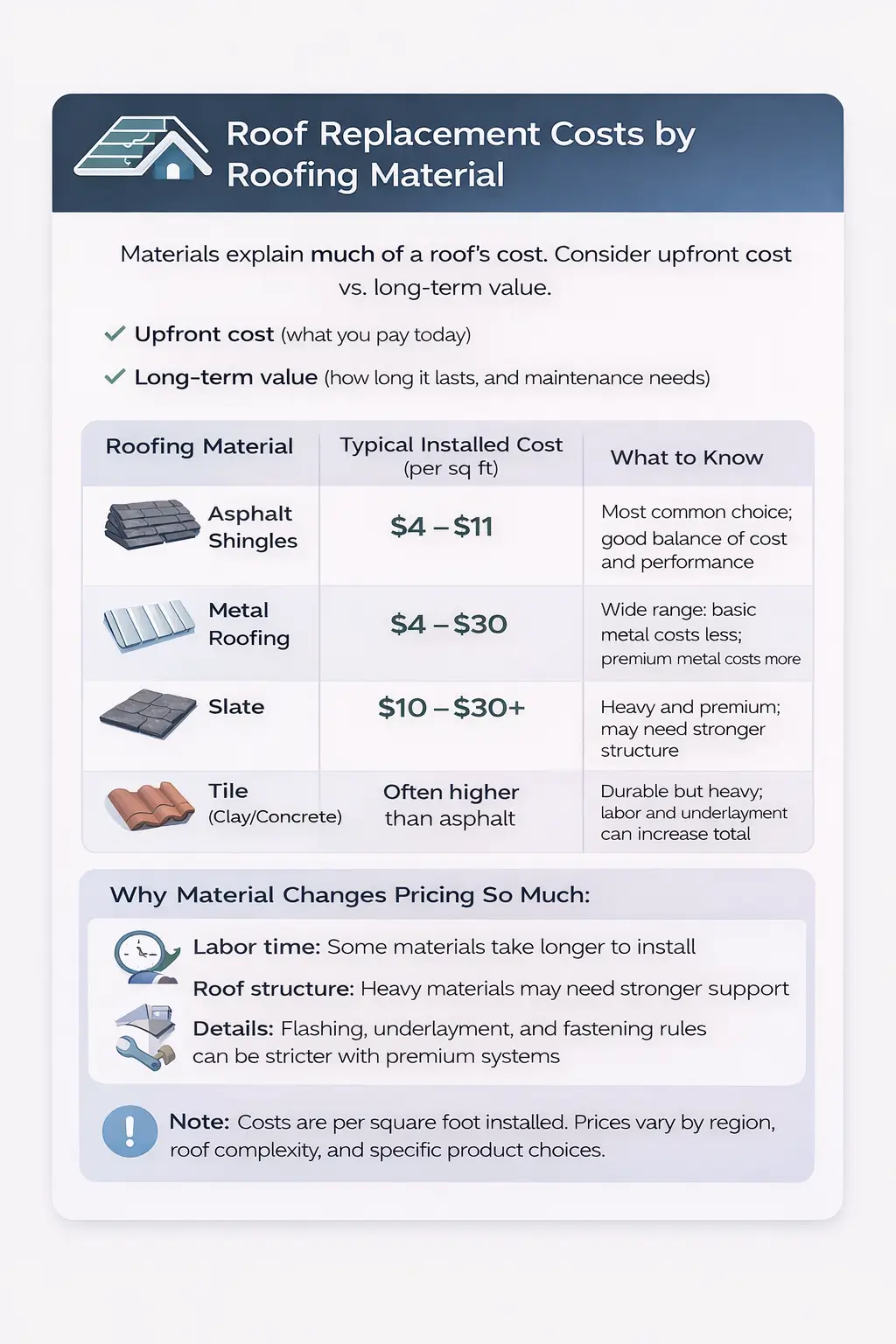
Material choice is the biggest factor in roof replacement cost. The following table shows typical installed cost ranges per square foot for common roofing materials in the U.S.
Keep in mind that prices can vary based on your location, roof complexity, and specific product choices.
| Roof Type (Installed) | Typical Cost Range (per sq ft) | Notes |
|---|---|---|
| Standard Roof Replacement | $4 – $11 | Common national estimate used for budgeting |
| Roof Replacement Average | $3.75 – $11 | Typical range; varies by material and complexity |
| Metal Roofing | $4 – $30 | Varies by metal type; copper is premium |
| Slate Roofing | $10 – $30 | Total installed cost also depends on labor/structure |
What this means for you: If you want the lowest upfront roof replacement cost, asphalt shingles are usually the default choice. If you want longevity and a premium look, metal or slate can cost more but may deliver long-term value depending on your goals.
Ask a roofer for a measurement, or use your home's footprint as a rough starting point (roof area is often larger than the footprint because of pitch).
For many homes, using a range like $4–$11 per sq ft gives a reasonable planning estimate.
Common add-ons include:
This is the part that often explains why two homes of the same size get very different quotes.
Estimate a baseline roof replacement cost using common US planning ranges. This is for budgeting only—final quotes vary by roof condition, local labor, and code rules.
Material choice can change your cost more than anything else.
A steep roof is slower and riskier to work on. Complex roofs (many valleys, hips, dormers, or skylights) require more cutting, flashing, and detail work.
If your roof has multiple layers of old shingles, removal takes longer and costs more. Disposal costs also vary by city and county.
If wood decking is damaged, it must be replaced before shingles go on. This can add cost unexpectedly—many contractors price this as "as needed" once the old roof is removed.
Here are the main location-driven reasons your quote may be higher or lower:
Get 3 written quotes and compare scope line-by-line (not just total price).
Ask what is included: tear-off, underlayment type, flashing, drip edge, ridge vent, cleanup, and disposal.
Ask about warranties: workmanship warranty vs. manufacturer warranty.
Confirm insurance and licensing (varies by state, but it matters everywhere).
Do not choose only by the lowest price—missing scope is a common reason for “cheap” quotes.
Paying for upgrades you do not need: Some upgrades help, but not every roof needs premium add-ons.
Skipping attic/vent checks: Poor ventilation can shorten roof life and cause moisture problems.
Not checking the scope: A low bid that excludes flashing or tear-off can become expensive later.
Not timing the job: Busy season can mean higher labor rates and longer schedules.
Look for repeated leaks, widespread missing shingles, sagging areas, or moisture damage in the attic. A roofer can confirm whether problems are isolated (repair) or system-wide (replacement).
Sometimes. Insurance may cover damage from a covered event (like wind or hail). Wear-and-tear and aging roofs are often not covered. Always read your policy and ask your insurer what documentation is required.
Ask about licensing (if required in your state), proof of insurance, who supervises the crew, how they protect landscaping, what is included in flashing/ventilation, and what warranties you get in writing.
Verify their business address, ask for recent local references, check complaint patterns (not just star ratings), and confirm they carry liability insurance and workers’ compensation.
Many homeowners choose late spring through early fall because weather is more predictable. However, scheduling during slower months may improve availability and sometimes pricing, depending on your market.
Many standard homes can be completed in a few days, but timing depends on weather, roof complexity, material type, and whether hidden repairs are found after tear-off.
Yes, most people do. Expect noise and vibrations during working hours. If you work nights, have infants, or have pets sensitive to noise, plan accordingly.